Leave a comment

Sweating in November

fan

It’s too bloody HOT!

What is up with this weather? It’s 70 degrees in November. This is not normal.

Unfortunately, back in October, my entire building converted from air conditioning to heat. So now, it’s 80 degrees in my apartment and I can’t sleep. There are three fans whirring away on high and I’m still sweating.

The weatherman just warned it might get cool on Thursday. I say bring it on!


Leave a comment

Defcon

 hacker

A recurring plot for thrillers, detective programs and major motion pictures involves the hiring of a miscreant, perhaps an expert safe cracker, to break-in to a facility in order for the employer to develop a better security system.

Looks like the U.S. government is learning from fiction. Officials attended Defcon in Las Vegas to recruit talented hackers to safeguard American network systems.

What I wouldn’t give to be a fly on the wall… it reads like an upcoming ALIAS episode.


Leave a comment

Science fiction reality

 hwang

In 2004, I met Dr. Hwang Woo Suk of South Korea following the announcement that his team had cloned human stem cells.

At the time I didn’t realize I was in the presence of a true pioneer. I thought he was another scientist celebrating a lucky break. Boy, was I wrong.

One year later, these stem-cell superstars managed to tailor stem cells to individual patients.

By the end of the year, Hwang hopes to open a world stem cell bank in Korea to speed up his pursuit of growing replacement tissue to treat diseases. This bank will consolidate current stem cell lines in one research location.

To treat a patient, researchers would look for a cell line that provides a close match to a patient’s immune system, resembling the process now used in finding donors for organ transplants.

And that’s not all, in their spare time they’ve successfully cloned a dog.

So while federal funds are restricted and research is limited here in the United States, researchers in South Korea are finding cures for Alzheimer’s Disease.

Now most people question the ethics of cloning and stem cell experiments. They ponder whether humans ought to play God and toy with the gift of life. They worry that science will run amuck and the world will be populated by replicas and unholy carbon copies.

Like Pope John Paul II’s condemnation of in vitro fertilization.

Here’s my question – how long will the US remain a “superpower” without the technological prowess we’ve enjoyed in the past?


Leave a comment

The most beautiful sphere in the world

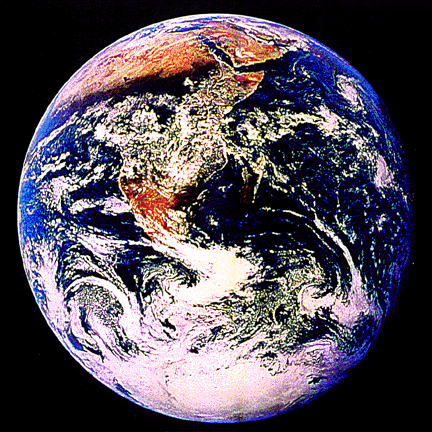
 earth

I get shivers when I look at photos of our planet. I think it’s the most beautiful thing I’ve ever seen.

Now I admit, I’m partial to blue and green and white color schemes, but even I couldn’t imagine a more perfect place to live.

Would I feel the same way if I had grown up on Mars? Had I lived in a constant rustish environment, would I be seduced by the red planet and believe it was the prettiest of them all? Or would I peer at my blue neighbor through a telescope and think, “Gosh, I really wish I lived on Earth.”

Or would Earth appear completely different, because its atmosphere had evaporated and the blue orb was no longer blue, but brown and beige and orange – more like Venus?

It really really upsets me when government leaders stand on the pulpit and declare there is no evidence of global warming. That the Earth’s climate goes through cycles, and killer hurricanes are just one small part of a normal weather pattern.

For the sake of the pretty blue ball we all call home… consider leaving the car in the garage and biking to the mall, ask the lady to bag your groceries in paper and not plastic, line-dry your clothes, turn off the air conditioning and lights when you leave your home (I know, I know, it’s bloody HOT out there, but every little bit counts).

As Commander Eileen Collins said today from the International Space Station that orbits 220 miles (352km) above the Earth, “The atmosphere almost looks like an eggshell on an egg, it’s so very thin. We know that we don’t have much air – we need to protect what we have.”


Leave a comment

Size matters

pluto

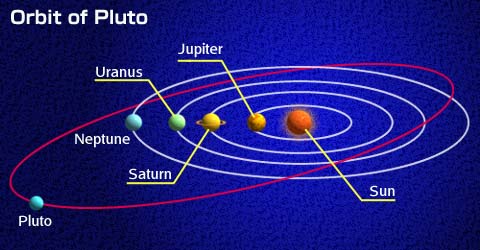
Poor Pluto is going through an identity crisis.

Some scientists believe it’s not really a planet, but some forlorn rock that belongs in the Kuiper Belt – the remains of the outer disk that originally formed our solar system.

Is this planetary discrimination? Or are we trying to force an object to fit into a system where it clearly doesn’t belong?

One problem is that scientists haven’t defined what a planet is. One general explanation is – an object whose luminosity is fainter than that of the star it orbits. Since Pluto orbits a star (the Sun, for those of you out there orbiting your own galaxy), and is also much less luminous, then it satisfies the criteria and stands a decent chance of retaining its status of 9th Planet.

But wait…. there’s also a matter of size.

Pluto is so small (2,200 kilometer diameter) it might not be worthy of full planet status. It’s less than half the size of any other planet in our system …. in fact it’s even smaller than our moon.

And it marches to the beat of its own drum, with an orbit at an angle from the plane of the other planets traveling around the Sun.

The 9th planet was discovered 75 years ago by an American, before the discovery of the Kuiper Belt. Astronomers now argue that had they known of the existence of the belt, Pluto would have been classified as a giant Kuiper Belt Object (KBO) – like Ceres in the Asteroid Belt.

Some believe the reason the debate hasn’t settled is because Pluto’s discovery in 1930 was made by U.S. astronomer Clyde Tombaugh – and it’s the only “planet” discovered by Americans.

Until this week.

A team of researchers from CalTech, Yale, and the Gemini Observatory in Hilo, HI, report the discovery of a new outer “planet” – 2003 UB313, a giant lump of rock and ice, and the largest object detected in the solar system since the discovery of Neptune and its moon Triton in 1846.

So once again astronomers can’t agree whether 2003 UB313 is a planet or just a suped-up asteroid. Its discoverers claim it is the 10th planet, but other astronomers, the ones who want to downgrade Pluto to a minor planet, insist it’s just another KBO.

Clearly, there are more important matters going on in the world.

I mean, who really cares whether Pluto and 2003 UB313 are classified as planets or KBOs or asteroids?

Our President on Monday endorsed teaching intelligent design as an alternative to evolution in our classrooms. This week, 21 Marines and an interpreter were killed in Iraq. And U.S. intelligence predicts Iran is about ten years away from manufacturing the key ingredient for a nuclear bomb – in other words they’ll probably have a weapon up and running in a couple years.

So why am I taking space to write about some obscure astronomical debate? Because it could turn vicious. Pluto’s fate is in the balance as well as millions of science textbooks and plastic placemats. And maybe, just maybe, a reasonable solution will appear that might inform other world crises.

There could be a compromise. Pluto could remain a planet, as well as a KBO. And all other KBOs would be categorized as KBOs, with no nonsense to recognize them as major planets.

So what do you think?


Leave a comment

The night sky

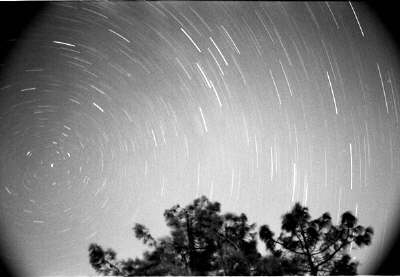
perseids

I end my day beneath hundreds of glow-in-the-dark stars that form initials of past loves, imaginary solar systems and favorite constellations like Cassiopeia and Orion.

One thing I miss about living in the city is the night sky. In Massachusetts, I would lay in a lawn chair, wrapped in an afghan, and wish on the stars as they’d sparkle in the night sky. I’d reach 1,000 and give up counting their multitudes, instead remembering the story of the star that led the three kings to the manger or recall William Shakespeare’s exquisite line from Henry VI about using stars to foretell events — “Comets, importing change of time and states, Brandish your crystal tresses in the sky.”

Stargazers, like me, have an exciting month coming up.

August 7 – The crescent moon meets Venus low in the western sky at dusk.

August 8 – Neptune reaches its closest approach to Earth in the constellation Capricorn.

August 11 – 12 – The Perseids build up after midnight and peak before dawn.

August 20 – 27 – Mercury meets Saturn in Cancer in the predawn eastern sky.

August 31 – Venus and Jupiter make a two-day close approach at dusk.


Leave a comment

Discovery in space

Discovery

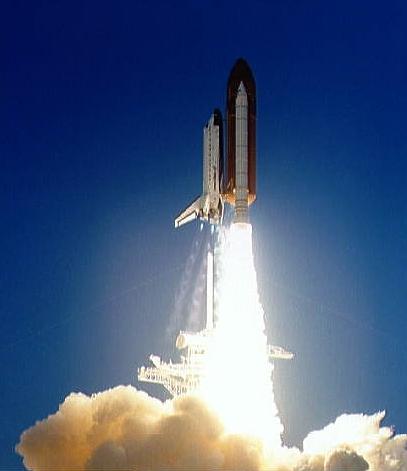
NASA celebrates a return to space with today’s successful launch of the Space Shuttle Discovery. This mission, the first since the Columbia tragedy more than two years ago, will test the new safety measures in place, including repair techniques. The crew will also participate in three spacewalks to replace broken parts on the International Space Station.

I know some people who don’t realize the shuttle missions halted back in 2003. That shocks me. To them, US space travel is a given, and they take for granted our ability to fly to the heavens.

Not me.

I think it’s a miracle that in one mere century, humans went from riding trains and trading in their horse-and-carriage for an automobile to stepping on the moon. It makes me wonder what new frontiers we’ll embark on in 2105.

How will we communicate? Will the 40-hour work week still exist? Where will tourists vacation? Will we purchase discount tickets on Expedia to one of several space stations? Or perhaps to a resort located at the bottom of the Atlantic Ocean?

In twelve days the shuttle will return to Earth, mission accomplished. Until then, god speed to the crew members on Discovery.