Leave a comment

How to Help

The First District police of Washington, DC, announced that 400 families will be arriving on Monday to stay in the Armory. Their needs at this time are bottled water and anything that would constitute a care package; for example, toothbrushes, toothpaste, blankets, undergarments, soap, etc. These items can be brought to the First District office located at 415 4th St SW.

Meanwhile the Washington Post published a list of online resources and ways to help the victims in the wake of Hurricane Katrina and in the ravaged Gulf coast area.

Or you can donate directly at the Red Cross.

If you live within 350 miles of the devastated area and can provide shelter, please visit HurricaneHousing.org.

Every little bit helps!


Leave a comment

Be prepared

New Orleans

Each morning I step into the kitchen and check a daily Bushism calendar that sits on top of the microwave oven. Here’s today’s entry –

“Home is important. It’s important to have a home.”—Crawford, Texas, Feb. 18, 2001

Hurricane Katrina has left thousands of area residents homeless. If you live within 300 miles of the devastated area and are able to provide a warm bed or shelter, please log on to hurricanehousing.org  to offer free housing.

Due to our president’s single-mindedness in the war against terror and his optimism that hurricane season would be a walk in the park, millions of dollars in budget cuts to disaster relief have been diverted to Homeland Security.

Meanwhile, thousands of people are stranded without food and water and basic sanitation as looters continue to ransack the city, afforded free reign.

Knight Ridder Newspapers –

“We’re not getting any help yet,” said Biloxi Fire Department Battalion Chief Joe Boney. “We need water. We need ice. I’ve been told it’s coming, but we’ve got people in shelters who haven’t had a drink since the storm.”

The slow response to Katrina and poor federal leadership is a replay of 1992’s mishandling of Hurricane Andrew, said former FEMA chief of staff Jane Bullock, a 22-year veteran of the agency.

The slowness is all too familiar to Kate Hale. As Miami’s disaster chief during Hurricane Andrew, Hale asked: “Where the hell’s the cavalry?”

May help soon arrive to the survivors in Katrina’s wake. And here’s to hope that our leaders are capable of learning from their mistakes.


Leave a comment

Golden oldies

 galaga

My grandfather would pick up my brother and I from school and drive us to the mall until my mom got home from work.

The routine was always the same. He’d have a Hershey bar for each of us – plain for my brother, with almonds for me. Then he’d park beside the Sears entrance. We’d spend about 30 minutes playing games on the computers in the tech department, while he stood and watched and laughed.

Then we’d stop at Papa Gino’s for a slice of cheese pizza, before continuing on to the bookstore. My brother would position himself in the animal/wildlife/nature section. My grandfather flipped through enormous books illustrating World War II. And I would head towards the young adult books, eager to know if the next installment of Sweet Valley High or the Sweet Dreams series had arrived.

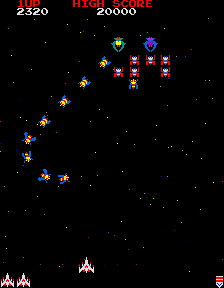
An hour later, the afternoon culminated at the video arcade. He’d give us each one dollar to play. My brother would bounce from one machine to the next, eager to master them all. But I would always steer toward Galaga.

I loved the premise. I was the hero-fighter defending Earth from the evil aliens coming to destroy her. I loved watching as the bug-things marched down the screen towards my ship, my fingers working double time to obliviate them all. I was greedy with my extra lives, watching as I earned extra ships to maintain the fight.

Although my actions would prove the contrary, I was always more of a reader.

We begged Santa for Atari and dad brought home a Gemini system he found on sale for $50 less. We eventually got used to playing the four games that came with the system. My favorite was Mousetrap.

A few years later the Atari 2600 replaced the Gemini system. By this point my baby brother was old enough to partake in video-game pleasure. And I was far too interested in MTv and the cable movie channels to make a fuss about game-time.

Many years later, a boyfriend presented me with a Gameboy and Tetris when I left for college. It was the perfect gift and I still play that game occasionally.

My brothers own Nintendo systems and Sega systems and virtual computer systems. They play football games and adventure simulations where the graphics are so real they resemble real-time sports coverage or Hollywood blockbusters.

My heart belongs to the classics… Galaga, Defender, Mousetrap, Pac-man, Pong and Donkey Kong.

And I bring all this up because this weekend America’s Video Game Expo will be at the Washington Convention Center from 10am – 5pm. So if you’re in town, think about stopping by and playing a game or two.


Leave a comment

And the theories keep on coming

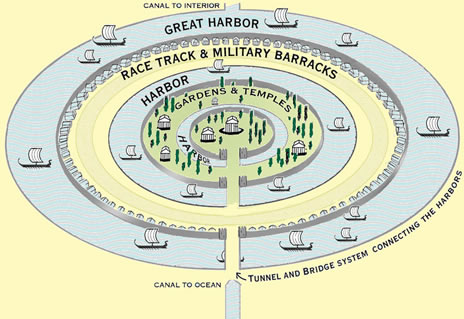
 Atlantis

Dr. Marc-André  Gutscher, a geologer from the University of Western Brittany in Plouzané, France, may have discovered the source of the Atlantis myth.

Spartel Island, located in the Gulf of Cadiz outside the Straits of Gibraltar, may once have laid 196 feet (60 m) above water.   The small island was originally proposed as the location of Atlantis by Jacques Collina-Girard from the University of the Mediterranean in Aix-en-Provence, France.

Then again, it seems a new theory pops up every couple years.

Like the Americans who believe that Atlantis lies off the coast of Cyprus.

Or off the coast of southern Spain.

Or the Iberian Peninsula.

Or smack in the middle of the Atlantic Ocean.

My two favorite theories are that:

1. Atlantis is on Antarctica and covered by sheets of ice and glaciers.

2. The Azores are all that is left of the ancient island continent.

Then again, the SciFi Channel is making a killing with it’s version of history told through Stargate Atlantis.

What’s your favorite theory?


Leave a comment

Speaking in tongues

 Empire of the World

In kindergarten, I would start off a conversation in English, switch over to Portuguese, insert a few French thoughts mid-stream before concluding in English. It drove my teacher and classmates insane. I was the oddball… the strange kid. But that was how we spoke at home.

So one day my teacher called my parents in for a meeting.

“Speak to her only in English,” was the message. And my immigrant parents heard it loud and clear.

So now I struggle to converse fluently in Portuguese, while my brothers have an understanding of the language but can’t speak it at all. I rue the day that well-meaning teacher instructed my parents to converse with their children in one language only.

To add to my language mania – I’ve also suffered from wanderlust for as long as I can remember. While other kids begged their parents for trips to Disney World, I wanted to visit the Eiffel Tower in Paris. Instead of building sand castles on the beach, I wanted to stroll the sands of Morocco.

My parents did not understand my desire to travel. I applied for a passport on my own and before my first day of college, I had visited the U.K., Germany and Yugoslavia.

I have a love affair with words and stories and language. The story of the world is the story of language.

While at the university I studied Chinese for four semesters before throwing in the towel as my GPA plummeted. One bookcase is filled with Pimsleur CD’s and instruction manuels. Another bookcase holds volumes on the history of language and mysteries of ancient tongues.

The Incan khipu is one such enigma that has baffled experts for centuries. Reports today tell of American anthropologists who have identified a three-knot pattern confirming the assumption that the colored strings were used for accounting information.

Communities live and share a common history through language. The khipu are the key to the historical information and stories of the Incas – a device no one on earth remembers how to translate.

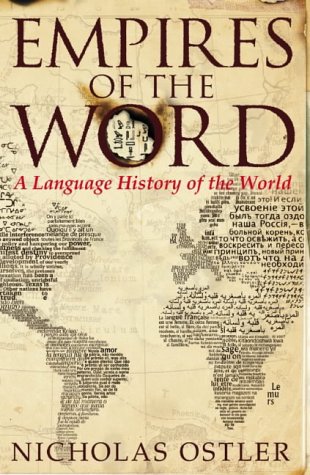
Last month I met Nicholas Ostler, chairman of the Foundation for Endangered Languages and a linguist with a working knowledge of 18 languages.

(18 languages! I have a working knowledge of THREE… I dream of understanding 15+ languages)

His book, Empires of the Word, tells tales of Sumerian innovations in education, culture, and diplomacy; the resilience of the Chinese language through 20 centuries of invasions; the birth of the modern languages of Europe; and the global spread of English.

Language failures are equally fascinating.

Why did the knowledge of the khipu not get passed down to Incan survivors? Why did Egyptian, which survived foreign takeovers for three millennia, succumb to Arabic? Why is Dutch unknown in modern Indonesia, though the Netherlands ruled the East Indies for as long as the British ruled India?

I know English and Portuguese. I have a working knowledge of French. I’m learning Spanish and Italian.

If I have my way, I’ll still manage to study and learn – Greek, Egyptian Arabic, German, Dutch, Russian, Mandarin, Farsi, Hungarian, Korean and Japanese.

Leave a comment

Defcon

 hacker

A recurring plot for thrillers, detective programs and major motion pictures involves the hiring of a miscreant, perhaps an expert safe cracker, to break-in to a facility in order for the employer to develop a better security system.

Looks like the U.S. government is learning from fiction. Officials attended Defcon in Las Vegas to recruit talented hackers to safeguard American network systems.

What I wouldn’t give to be a fly on the wall… it reads like an upcoming ALIAS episode.


Leave a comment

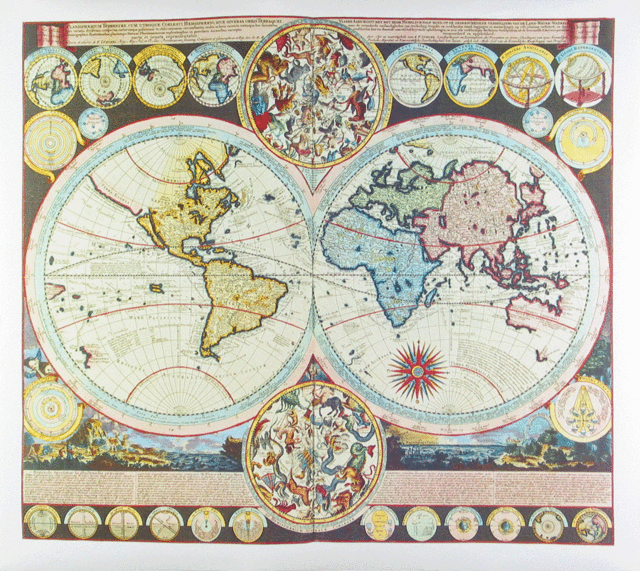
Cartography

 world map

In the town I grew up in, at one corner of a four-way intersection, stands an odd-shaped structure reminiscent of the all-purpose buildings that existed in colonial days. In the 1700’s, it served as a general store/pharmacy/post office. But in the 21st century, that building is filled with glass counters that display beaded jewelry and stone arrowheads and old-fashioned scales and other treasures made open to the public in the spring and summer seasons.

The interior is wide open with a second-story loft-like space that might have been an office in its previous incarnation, and now was a library of sorts. Manuscripts and cloth-bound books line the wooden shelves nailed to two of the three walls. A makeshift bench waits beneath the one multi-paned window.

My mother knew if I went missing, she could locate me in that confined space, surrounded by ancient elementary primers and almanacs and town history and holy books. Some days I could crack the window open to let in a delicate breeze, but most times the air was stagnant with mildew and dust and something sweet.

I spent hours sitting beneath that window carefully turning the pages of a town atlas and studying the outlines to plots of land or the path of forgotten railroad tracks or neighborhoods now covered by sand. The maps captured my imagination.

Across town on the former Main Street, the town hall and public library stand adjacent to one another. These structures aren’t as old as the museum and look completely different. They resemble miniature castles.

As a child, I thought the library was enormous…. and haunted. The main reading room boasts a grand stone fireplace and a spiral wrought-iron staircase leading to a whimsical attic filled with town depravities. Or so I thought.

While researching the war for independence for a social studies report, I’d imagine the day-to-day activities of a family who might have resided in the library when it was a mansion. I’d picture an entire meal – complete with dinner menu and topics of conversation – before reluctantly returning to the present.

You can’t imagine my disappointment when I finally learned that the stone building, complete with my beloved turrets, had been constructed to house the library and was never used for anything else.

So the size of the library diminished in proportion to my age, and by the time I was a senior in high school, I had graduated to the marble branch in the small city nearby.

This hushed haven suited me. One afternoon, while I strolled beneath soaring arches and explored many rooms, I wandered into a utopia. Low bookcases lined the small room, with framed maps covering the wood panel walls. At the center was a small wooden table surrounded by four green leather chairs.

My last year of high school, I’d study in this room surrounded by maps. It was my heaven.

And although I was often alone in this room, I never thought of stealing any of the maps. Then again, if I’d found any worth $700,000 I might have considered it.


Leave a comment

Science fiction reality

 hwang

In 2004, I met Dr. Hwang Woo Suk of South Korea following the announcement that his team had cloned human stem cells.

At the time I didn’t realize I was in the presence of a true pioneer. I thought he was another scientist celebrating a lucky break. Boy, was I wrong.

One year later, these stem-cell superstars managed to tailor stem cells to individual patients.

By the end of the year, Hwang hopes to open a world stem cell bank in Korea to speed up his pursuit of growing replacement tissue to treat diseases. This bank will consolidate current stem cell lines in one research location.

To treat a patient, researchers would look for a cell line that provides a close match to a patient’s immune system, resembling the process now used in finding donors for organ transplants.

And that’s not all, in their spare time they’ve successfully cloned a dog.

So while federal funds are restricted and research is limited here in the United States, researchers in South Korea are finding cures for Alzheimer’s Disease.

Now most people question the ethics of cloning and stem cell experiments. They ponder whether humans ought to play God and toy with the gift of life. They worry that science will run amuck and the world will be populated by replicas and unholy carbon copies.

Like Pope John Paul II’s condemnation of in vitro fertilization.

Here’s my question – how long will the US remain a “superpower” without the technological prowess we’ve enjoyed in the past?