Leave a comment

Lessons Learned Review

Scott McClellan

White House Press Secretary Scott McClellan says the Bush administration is conducting a lessons learned review into what went wrong with the government’s response to Hurricane Katrina when it hit the Gulf Coast in August 2005.

So I thought I’d conduct a lessons learned review of my own.

  1. If there is a national emergency, I am on my own.
  2. Have a plan – when the infrastructure collapses around me, knowing where I’m going will save stress and ease heartache.
  3. Keep cash on hand – I probably won’t have access to ATMs and banks.
  4. Being insured isn’t the insurance it once was. Save now for that rainy day. If there’s an incident of national significance, I need to be prepared to pay my way for months.
  5. Be prepared to help others along the way…. karma is a two way street.
  6. It is not crazy to stockpile water, cans of tuna, first aid supplies and batteries.
  7. Don’t panic and remember to breathe.
  8. Expect long lines and lots of delays — so carry a couple good books to read during the waits.
  9. It’s better to travel in pairs…. so find a buddy to commiserate with.
  10. Count my blessings and maintain a sense of humor.


Do you have anything to add? Or maybe you’ve got your own lessons learned review?


Leave a comment

Sweating in November

fan

It’s too bloody HOT!

What is up with this weather? It’s 70 degrees in November. This is not normal.

Unfortunately, back in October, my entire building converted from air conditioning to heat. So now, it’s 80 degrees in my apartment and I can’t sleep. There are three fans whirring away on high and I’m still sweating.

The weatherman just warned it might get cool on Thursday. I say bring it on!


Leave a comment

And the theories keep on coming

 Atlantis

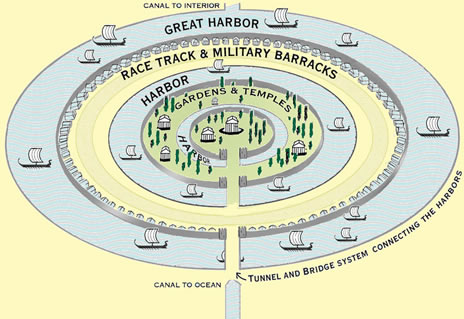
Dr. Marc-André  Gutscher, a geologer from the University of Western Brittany in Plouzané, France, may have discovered the source of the Atlantis myth.

Spartel Island, located in the Gulf of Cadiz outside the Straits of Gibraltar, may once have laid 196 feet (60 m) above water.   The small island was originally proposed as the location of Atlantis by Jacques Collina-Girard from the University of the Mediterranean in Aix-en-Provence, France.

Then again, it seems a new theory pops up every couple years.

Like the Americans who believe that Atlantis lies off the coast of Cyprus.

Or off the coast of southern Spain.

Or the Iberian Peninsula.

Or smack in the middle of the Atlantic Ocean.

My two favorite theories are that:

1. Atlantis is on Antarctica and covered by sheets of ice and glaciers.

2. The Azores are all that is left of the ancient island continent.

Then again, the SciFi Channel is making a killing with it’s version of history told through Stargate Atlantis.

What’s your favorite theory?


Leave a comment

Speaking in tongues

 Empire of the World

In kindergarten, I would start off a conversation in English, switch over to Portuguese, insert a few French thoughts mid-stream before concluding in English. It drove my teacher and classmates insane. I was the oddball… the strange kid. But that was how we spoke at home.

So one day my teacher called my parents in for a meeting.

“Speak to her only in English,” was the message. And my immigrant parents heard it loud and clear.

So now I struggle to converse fluently in Portuguese, while my brothers have an understanding of the language but can’t speak it at all. I rue the day that well-meaning teacher instructed my parents to converse with their children in one language only.

To add to my language mania – I’ve also suffered from wanderlust for as long as I can remember. While other kids begged their parents for trips to Disney World, I wanted to visit the Eiffel Tower in Paris. Instead of building sand castles on the beach, I wanted to stroll the sands of Morocco.

My parents did not understand my desire to travel. I applied for a passport on my own and before my first day of college, I had visited the U.K., Germany and Yugoslavia.

I have a love affair with words and stories and language. The story of the world is the story of language.

While at the university I studied Chinese for four semesters before throwing in the towel as my GPA plummeted. One bookcase is filled with Pimsleur CD’s and instruction manuels. Another bookcase holds volumes on the history of language and mysteries of ancient tongues.

The Incan khipu is one such enigma that has baffled experts for centuries. Reports today tell of American anthropologists who have identified a three-knot pattern confirming the assumption that the colored strings were used for accounting information.

Communities live and share a common history through language. The khipu are the key to the historical information and stories of the Incas – a device no one on earth remembers how to translate.

Last month I met Nicholas Ostler, chairman of the Foundation for Endangered Languages and a linguist with a working knowledge of 18 languages.

(18 languages! I have a working knowledge of THREE… I dream of understanding 15+ languages)

His book, Empires of the Word, tells tales of Sumerian innovations in education, culture, and diplomacy; the resilience of the Chinese language through 20 centuries of invasions; the birth of the modern languages of Europe; and the global spread of English.

Language failures are equally fascinating.

Why did the knowledge of the khipu not get passed down to Incan survivors? Why did Egyptian, which survived foreign takeovers for three millennia, succumb to Arabic? Why is Dutch unknown in modern Indonesia, though the Netherlands ruled the East Indies for as long as the British ruled India?

I know English and Portuguese. I have a working knowledge of French. I’m learning Spanish and Italian.

If I have my way, I’ll still manage to study and learn – Greek, Egyptian Arabic, German, Dutch, Russian, Mandarin, Farsi, Hungarian, Korean and Japanese.



Leave a comment

Defcon

 hacker

A recurring plot for thrillers, detective programs and major motion pictures involves the hiring of a miscreant, perhaps an expert safe cracker, to break-in to a facility in order for the employer to develop a better security system.

Looks like the U.S. government is learning from fiction. Officials attended Defcon in Las Vegas to recruit talented hackers to safeguard American network systems.

What I wouldn’t give to be a fly on the wall… it reads like an upcoming ALIAS episode.


Leave a comment

Science fiction reality

 hwang

In 2004, I met Dr. Hwang Woo Suk of South Korea following the announcement that his team had cloned human stem cells.

At the time I didn’t realize I was in the presence of a true pioneer. I thought he was another scientist celebrating a lucky break. Boy, was I wrong.

One year later, these stem-cell superstars managed to tailor stem cells to individual patients.

By the end of the year, Hwang hopes to open a world stem cell bank in Korea to speed up his pursuit of growing replacement tissue to treat diseases. This bank will consolidate current stem cell lines in one research location.

To treat a patient, researchers would look for a cell line that provides a close match to a patient’s immune system, resembling the process now used in finding donors for organ transplants.

And that’s not all, in their spare time they’ve successfully cloned a dog.

So while federal funds are restricted and research is limited here in the United States, researchers in South Korea are finding cures for Alzheimer’s Disease.

Now most people question the ethics of cloning and stem cell experiments. They ponder whether humans ought to play God and toy with the gift of life. They worry that science will run amuck and the world will be populated by replicas and unholy carbon copies.

Like Pope John Paul II’s condemnation of in vitro fertilization.

Here’s my question – how long will the US remain a “superpower” without the technological prowess we’ve enjoyed in the past?


Leave a comment

Food for thought

 for the birds

Borrowing a page from Mahatma Gandhi’s philosophy on non-violence, inmates at El Paso County Jail in Colorado went on a brief hunger strike to combat unnecessary cruelty.

After surviving five straight days of turkey dinners the prisoners protested this inhumane punishment by refusing to eat.

(And all this time I thought convicts were fed bread and water in prison. Silly me.)

Officials finally reasoned with the inmates and explained that the turkey meals were not a form of punishment – unlike the threat of water boarding (dripping water into a wet cloth over the suspect’s face so it feels like drowning).

And since U.S. policy has embraced such novel interrogation methods for detainees, prison officials have toyed with the possibility of instituting these new policies across the board at all U.S. detention centers, for all prisoners.

Within 30 minutes the strike ended.

Meanwhile, on the other side of the globe in Iran, investigative reporter Akbar Ganji is also on a hunger strike. The journalist, imprisoned in April 2000 and charged with acting against national security for participating in an academic conference in Berlin, was sentenced to ten years imprisonment plus five years of exile.

Ganji staged this hunger strike to protest his treatment in prison. His health is in serious decline after losing more than 50 pounds in 55 days. He is very weak, frequently loses consciousness, and is in danger of starving to death say human rights groups who continue to monitor his condition.

Now forgive my ignorance – but what exactly is the point of a hunger strike?

I know it’s a form of non-violence and political protest, but how does it motivate a tyrant to action? Government officals in Iran obviously don’t care about an enemy of the state starving to death in prison. Eight nobel laureates fom three countries have appealed to Iran to release Ganji and still nothing – no response.

And in a surprise move, even President Bush issued a statement expressing outrage at Ganji’s imprisonment and in Iran’s refusal to allow him legal representation and access to family.

Now you can just imagine how well that went over. I think I can still hear hoots of laughter coming from that region of the world.

But getting back to the purpose of starving yourself in protest. Remind me – what IS the point?

I mean if I went on a hunger strike today to protest against the war in Iraq, my maintenance guy would find my dead body in October and chalk it up to another incident of DC mortality.